EDS 232
Lesson 7
Cross-validation
In this lesson
- The validation set approach
- K-fold cross-validation and how to compute fold errors
- Using cross-validation to select hyperparameters
- Using cross-validation to compare models
Our example dataset
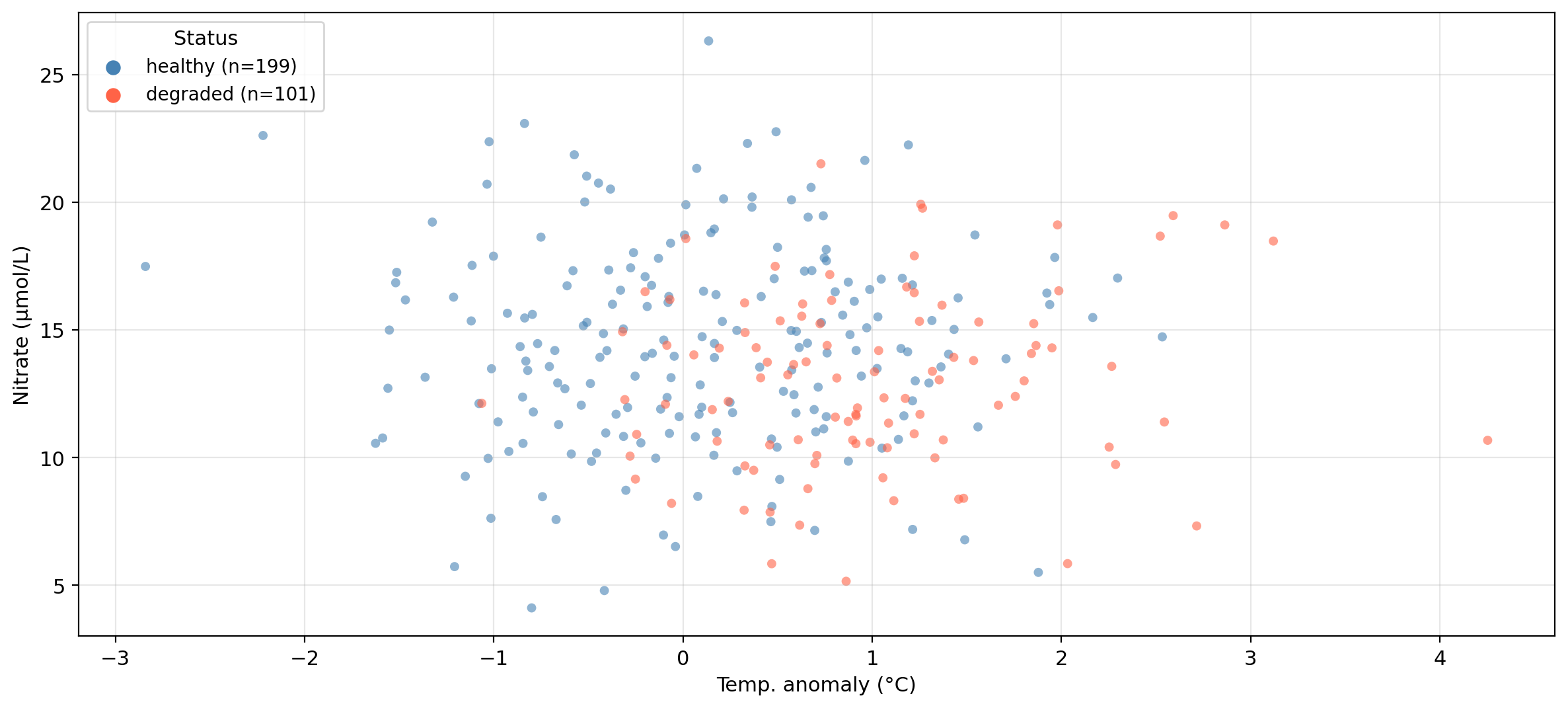
The same synthetic dataset from the previous lessons — 300 coastal monitoring stations:
temp_anomaly — sea surface temperature anomaly (°C)nitrate — nitrate concentration (μmol/L)status — kelp forest condition: healthy or degraded
Previous lesson: used logistic regression to predict kelp forest status.
Today: how to make that process more rigorous.
Data overview
Synthetic data generated for educational purposes only
A motivating example
Recall: we classify a site as healthy if \(p(X) \geq \alpha\), degraded otherwise.
The default is \(\alpha = 0.5\), but the best threshold for our data may be different.
Idea: try many values of \(\alpha\), measure accuracy on the test set, pick the best.
Accuracy at default  α = 0.50:        0.711
Best threshold found on test set: α = 0.59
Accuracy at that threshold:           0.722
We found a threshold that beats the default: but is there something wrong with this process?
Data leakage
We used the test set to make a modeling decision: we examined the test set outcomes to figure out which threshold works best, then reported accuracy on those same observations.
We selected \(\alpha\) because it happened to work well on these 90 test observations — not because it generalizes well.
This is called data leakage: information from the test set leaked into our modeling process. The reported accuracy is no longer an honest estimate of performance on truly new data.
The workflow we have been using
The workflow we have been using
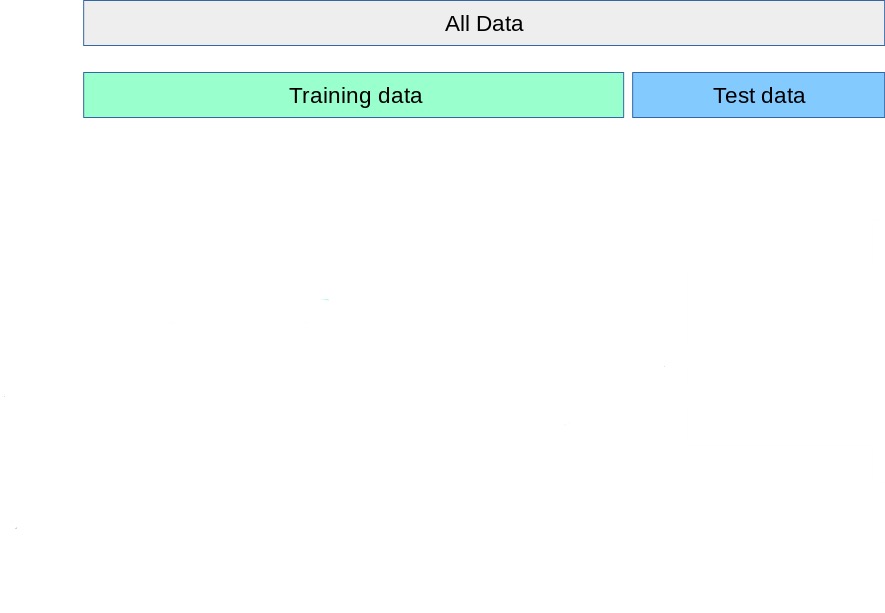
- Split data into a training set and a test set.
- Fit the model on the training set.
- Evaluate performance on the test set.
![]()
This works well to report metrics for a single, already-decided model, but breaks down when we need to make any modeling decision.
A fix: cross-validation
We would want to:
- make all modeling decisions using only the training data,
- estimate the test set’s accuracy metrics, and
- keep the test set sealed until the very final evaluation.
Cross-validation is a standard tool for doing this:
- splits the training data into temporary training and validation subsets,
- fits the model on each split, and
- averages the resulting errors to produce an estimate of test performance.
The test set is only used once, for the final reported result.
The validation set approach
The validation set approach
The validation set approach
The simplest resampling method:
- Randomly divide the training observations into a training set and a validation set.
- Fit the model on the (smaller) training set.
- Compute the error on the validation set.
- The validation error estimates the test error.
![]()
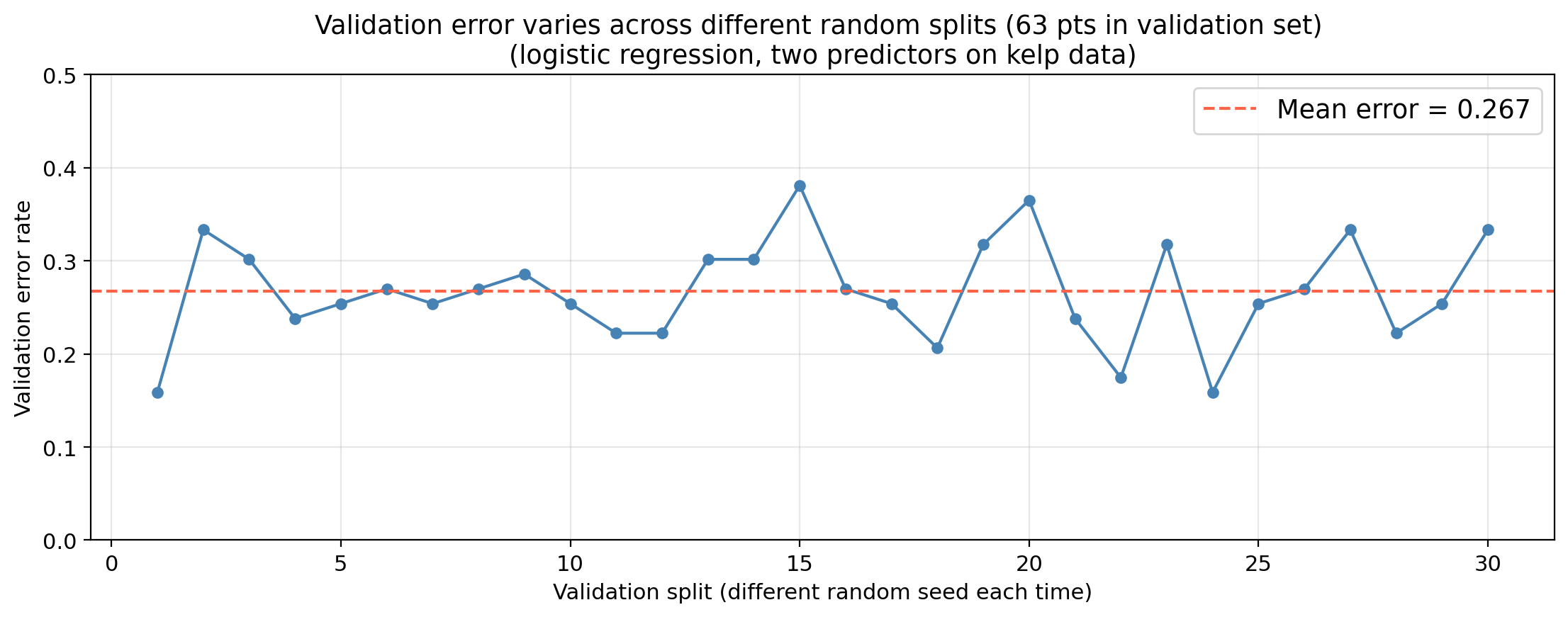
Drawback 1: high variance
Same model, same data, only the split changes. The error estimate varies substantially across splits.
Check-in
The training set for the kelp data has 210 points.
If you used a 50/50 split (105 points for training / 105 for validation),
what would be a bigger concern:
the validation error being much higher or much lower than the test error?
The concern would be that the validation error is higher than the test error the validation error estimates performance of a model trained on only 105 observations, but the final model will be trained on all 210.
More training data almost always produces a better model, so for the validation set approach, the validation error overestimates the true test error.
Drawback 2: missing training data
Setting aside part of the training data for validation means the model is fit on fewer observations than we will ultimately use.
Models fit on less data tend to perform worse, so the validation error will tend to overestimate the true test error of the final model (which will be trained on all the data). This could lead to us selecting a sub-optimal model.
K-fold cross-validation addresses both of these drawbacks.
\(k\)-fold cross-validation
\(k\)-fold cross-validation
![]()
\(k\)-fold cross-validation
![]()
\(k\)-fold cross-validation
![]()
\(k\)-fold cross-validation
![]()
\(k\)-fold cross-validation
![]()
\(k\)-fold cross-validation
![]()
\(k\)-fold cross-validation
![]()
\(k\)-fold cross-validation
![]()
\(k\)-fold cross-validation
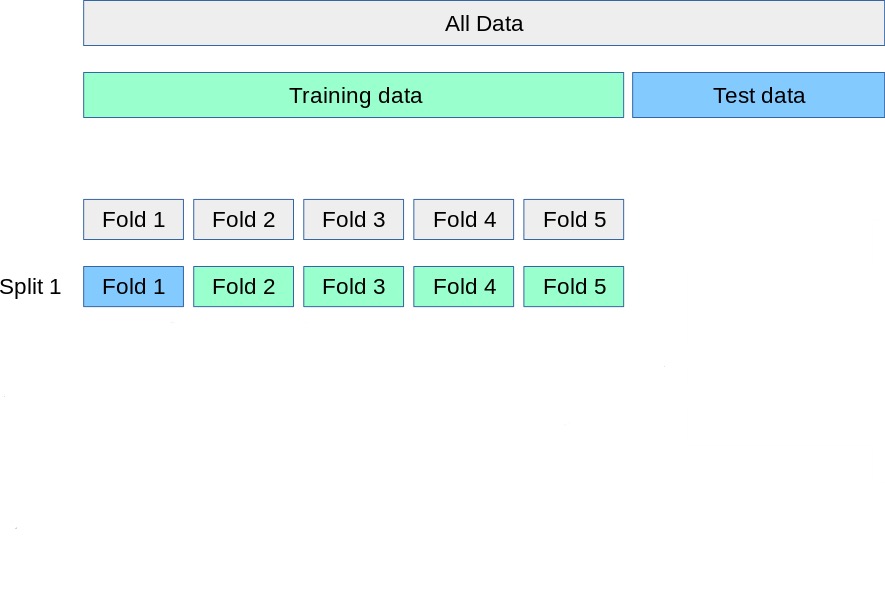
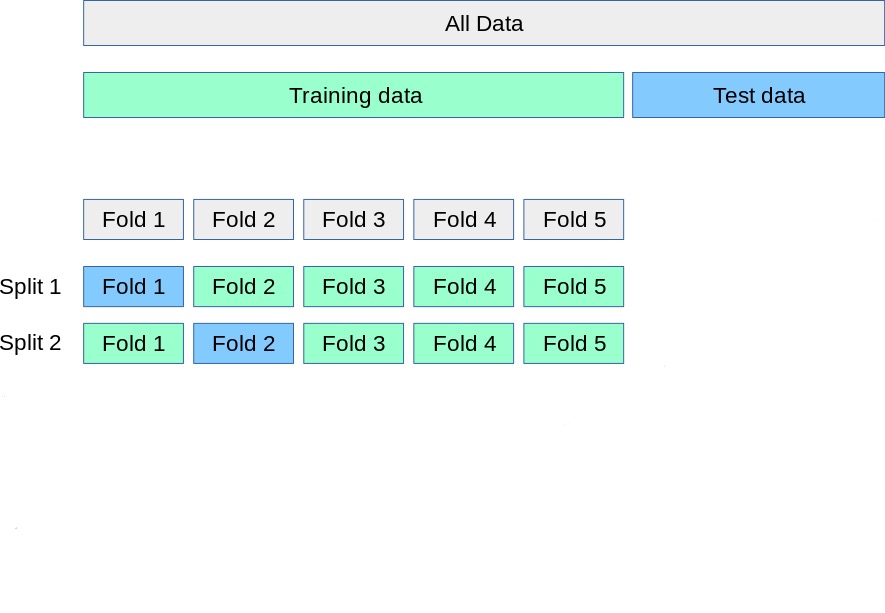
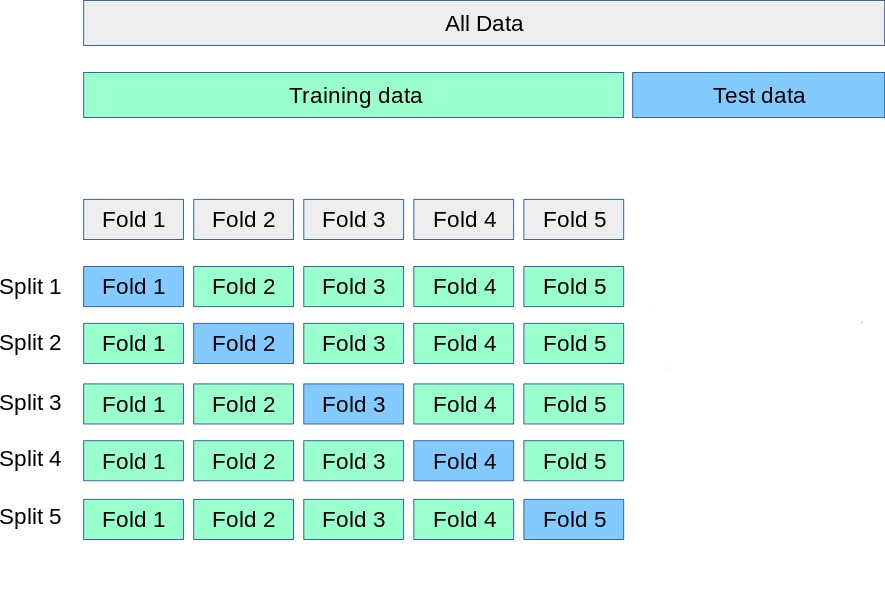
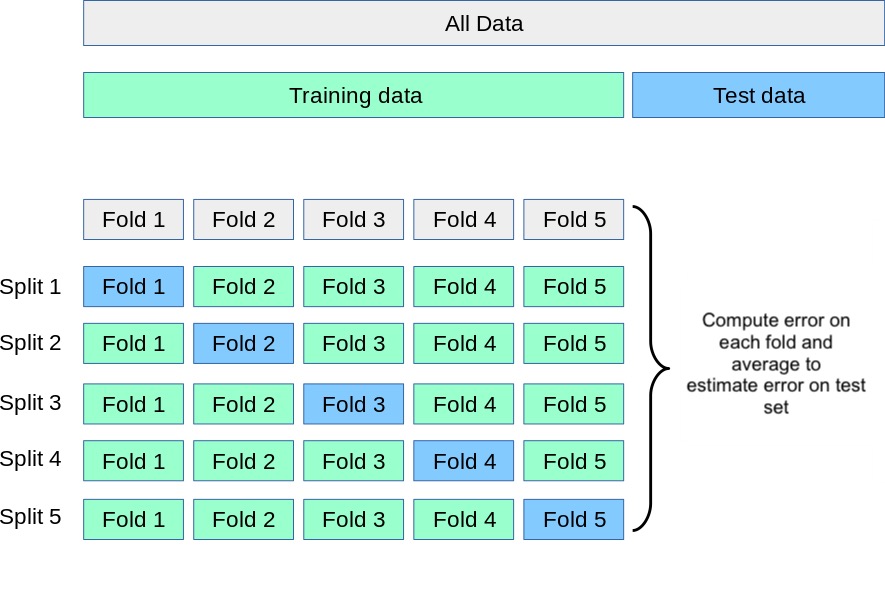
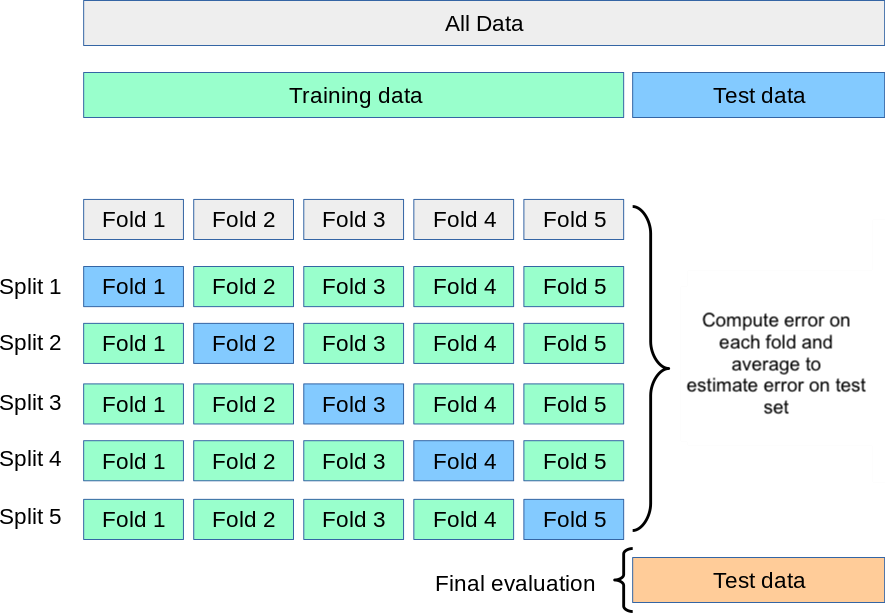
A standard resampling method. We use the following steps:
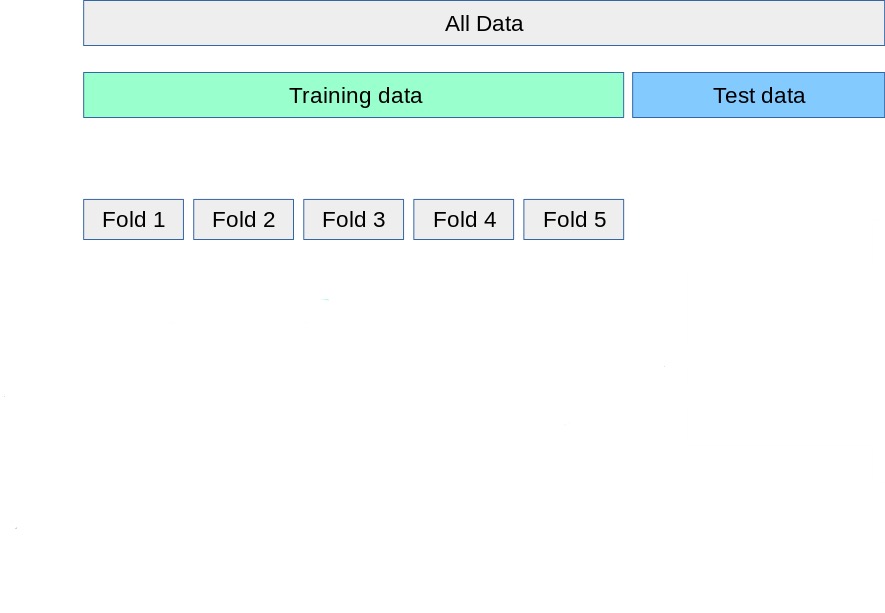
- Randomly divide the training set into \(k\) roughly equal-sized folds.
- Hold out fold 1 as the validation set; fit the model on the remaining \(k - 1\) folds.
- Compute the error \(\text{Err}_1\) on the held-out fold.
- Repeat for each of the \(k\) folds.
- Average the \(k\) fold errors to get an estimate of the test error:
\[\text{CV}_{(k)} = \frac{1}{k} \sum_{i=1}^{k} \text{Err}_i\]
In practice, use \(k = 5\) or \(k = 10\): each fold trains on 80–90% of the data, fitting only 5 or 10 models.
Check-in
Our dataset has 210 observations in the training set and 90 in the test set. By using 5-fold CV on our workflow:
- How many observations are in each fold?
- How many observations are used to train the model in each iteration?
- \(210 / 5 = 42\) observations per fold.
- \(210 - 42 = 168\) observations for training in each iteration.
Computing the fold error
We have:
- \((x_1, y_1), ... (x_n, y_n)\) = the training set which will be split into folds
- \(n_i\) = number of observations in the \(i\)-th fold
- \(\hat{y}_j\) = the prediction made on \(y_j\) by the corresponding CV model
How we measure \(\text{Err}_i\) on the \(i\)-th fold depends on the type of problem.
Regression: typically use the Mean Squared Error (MSE):
\[\text{Err}_i = \frac{1}{n_i} \sum_{j \in \text{fold } i} (y_j - \hat{y}_j)^2\]
Classification: typically use the error rate:
\[\text{Err}_i = \frac{\text{number of misclassified observations in $i$-th fold }}{\text{number of observations in $i$-th fold}}\]
Two caveats for implementation
Caveat 1: feature scaling must happen inside the CV loop
Models that rely on distances (e.g., KNN) are sensitive to feature scale. If you standardize the full training set before splitting into folds, the validation fold’s statistics were computed using the whole dataset (data leakage). The scaler must be fit on the training folds only and then applied to the validation fold.
Caveat 2: use stratified folds for classification
Plain k-fold shuffles without regard to class labels. For classification — especially with class imbalance — this can produce folds where one class is barely represented, making error estimates noisy. Stratified K-fold preserves the class proportion of the full training set in each fold and is the standard practice.
Using CV to select a hyperparameter
Hyperparameters
A hyperparameter is any setting chosen by the analyst that cannot be learned from the training data during model fitting. For example, the number of neighbors \(K\) in the \(K\)-Nearest neihbors model
Choosing a hyperparameter by optimizing against the test set is another example of data leakage.
Selecting a hyperparameter with CV
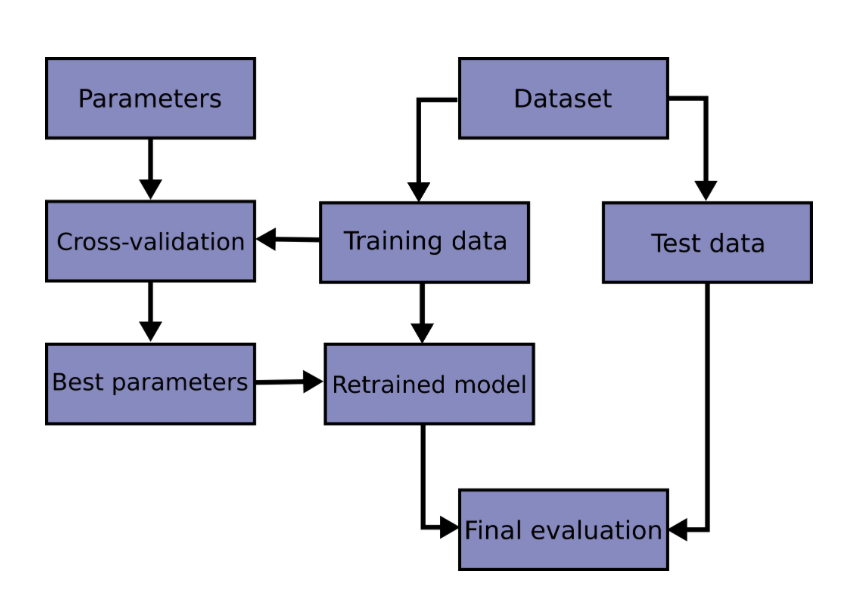
- Identify the hyperparameter to tune.
- For each hyperparameter candidate value, compute the \(k\)-fold CV error on the training set.
- Select the hyperparameter value with the lowest CV error.
- Refit the model using the selected hyperparameter on the full training set.
- Evaluate the final model once on the test set to report the accuracy metrics.
The test set never influences the selection, so we are not inadvertently tuning our model to perform on the test set.
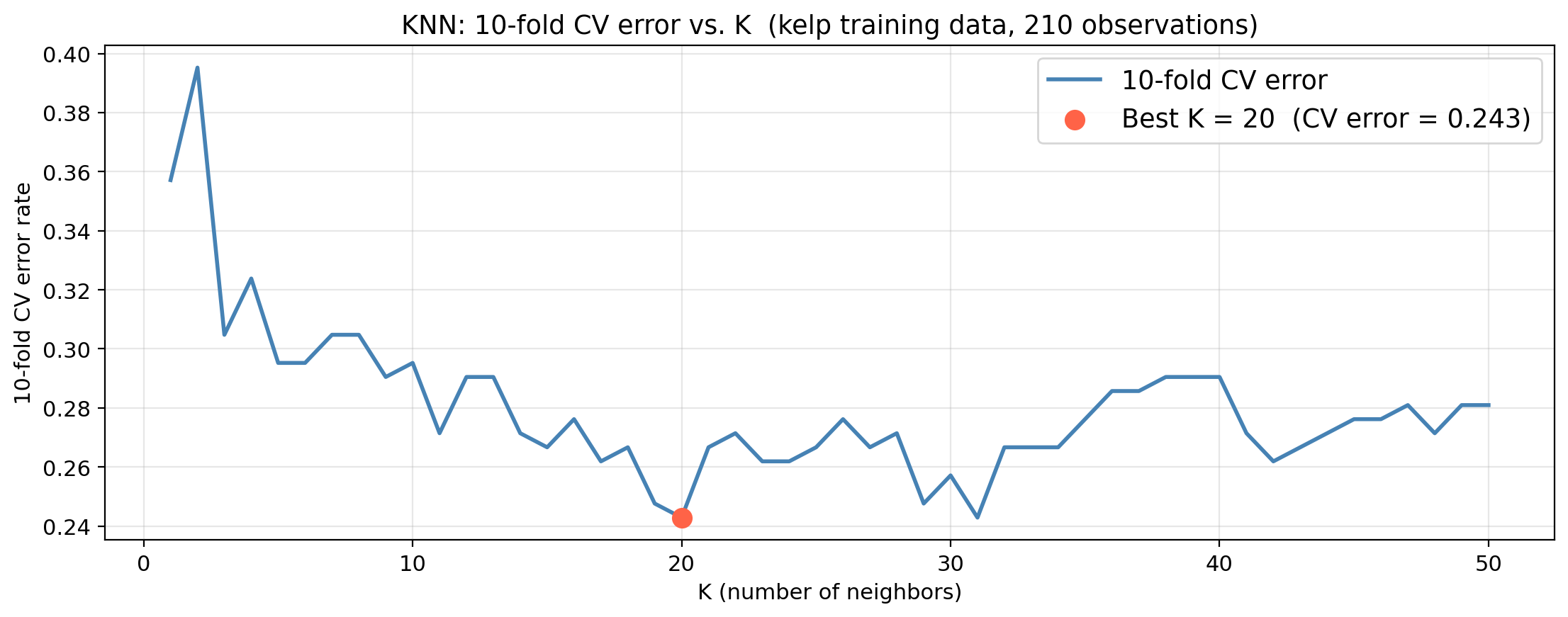
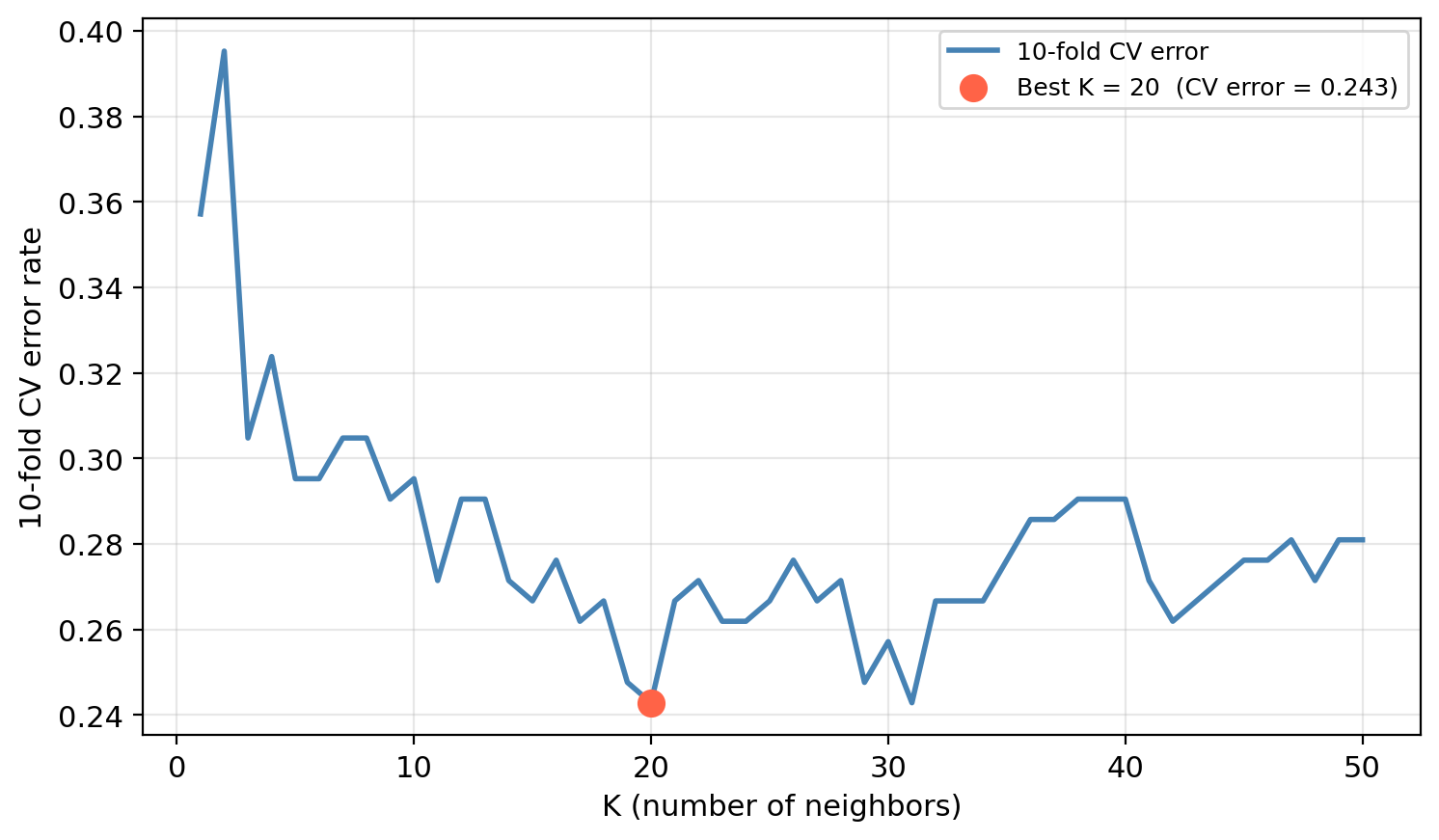
KNN hyperparameter selection: kelp data
We decide to tune the hyperparameter \(K\) using CV.
For each value of \(K\) we estimate the test error rate using 10-fold CV.
Check-in
Once \(K\) is selected, on what data would you fit the final model?
Why is using the test set to select \(K\) not the best practice?
Check-in
Once \(K\) is selected, on what data would you fit the final model?
Why is using the test set to select \(K\) not the best practice?
On the full training set (all 210 obs). CV only informs the choice of \(K\).
The test set would influence the modeling decision. The reported accuracy would reflect optimization for the specific test set observations, not true generalization.
Comparing models with CV
CV can be used to compare different model types on the same training data before touching the test set.
Once a model is selected using CV, we can refit on the full training set and report its performance on the test set once, as a final evaluation.
We use the same folds for all models so that differences in CV error reflect the model, not randomness in how the data was split.
10-fold CV error for three candidate models on the kelp training data:
                    Model CV error
               KNN (K=20)    0.243
     Logistic (temp only)    0.295
Logistic (temp + nitrate)    0.243
Which model would you select and why? What other considerations would you take into account to decide?
Earlier we saw that selecting the classification threshold using the test set leads to data leakage. How is using CV to compare these three models solving the same underlying problem?
The full modeling workflow
![]()
CV guides decisions made during model development.